Lab-Made Ball Lightning, a Snake Robot, and Turning Mercury Into Gold: Tech Briefs #44

Every week in Tech Briefs, we round up research, development, and innovation stories that could shape the future. We track what’s happening in AI, chips, robot (in Czech)ics, quantum computing, and space. Here’s each story in a few quick lines:
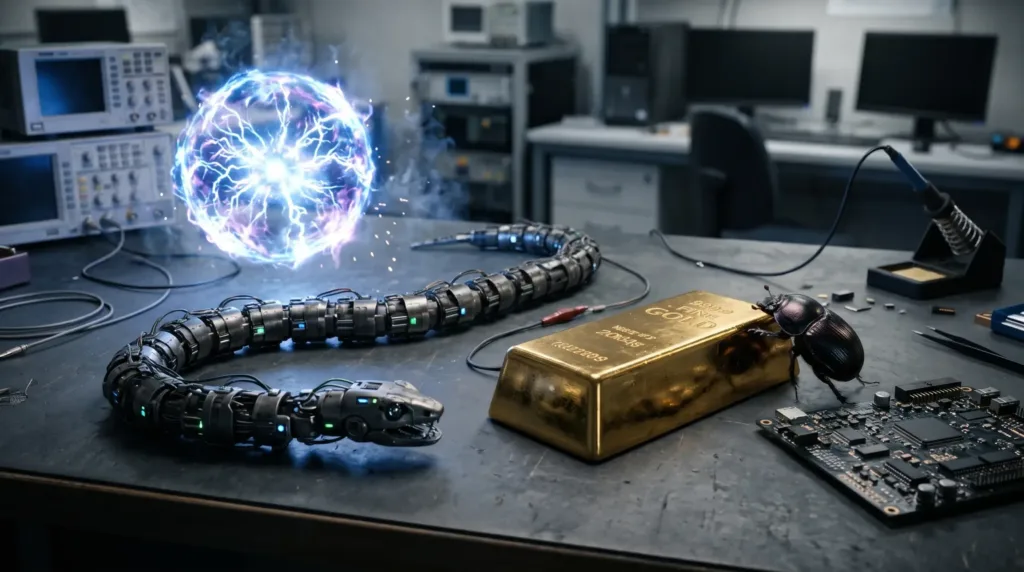
Scientists copied a dung beetle’s ability to fly in a straight line. Dung beetles can scan the sky and use cues like the position of the Sun, Moon, stars, and the Milky Way to stay on course. Swedish researchers used that idea to design a miniature neural circuit, and in testing the robot behaved much like the insect. The work could help build more efficient navigation systems for autonomous robots, drones, and unmanned vehicles, especially when GPS isn’t available.
Google has put its first data center satellite into orbit. Suncatcher is now online and carries four TPUs, though only one runs at a time. Engineers deployed the Gemma 4 model on board, and its first output was a haiku. SpaceX launched the satellite.
The first robot built for explosive environments has entered production. The four-legged ANYmal X uses a set of AI systems to carry out routine autonomous inspections in hazardous settings. It packs temperature, visual, acoustic, and gas sensors to detect overheating, chemical leaks, unusual sounds, and equipment wear.
DeepMind’s Genie 4 generates photorealistic worlds in real time. For the first time, it includes its own generated audio and characters you can talk to live. The scene can also be changed on the fly with prompts.
A snake robot can deliver drugs and perform diagnostics in the small intestine. MIT researchers developed a robot called BIOSENTER that moves using scale-like protrusions. It includes tools for imaging, biopsy, and drug delivery. It has already been tested in pigs, with human trials expected to follow.
This voice model can speak and listen at the same time. Dessa is trained on human conversations and handles pauses, breathing, and sarcasm. It runs locally, with both audio input and audio output.
An optical sensor can identify substances by how they interact with light. British researchers designed a chip that classified foods, medicines, and plastics with 100 percent accuracy in testing. It also measured glucose, alcohol, and lactate. Clinical studies are still needed before consumer or medical use. The chip costs just $10.
Marathon turned mercury into gold using neutrons from fusion reactions. The company claims it beat CERN’s previous record by a factor of 10. The cost of production, however, is still far too high to be practical.
Chinese physicists created ball lightning in the lab. In the experiment, they fired an ultrashort laser pulse along a tungsten tip into an argon atmosphere. The resulting structure reached a maximum size of about 100 micrometers. According to the theory, ball lightning is a type of electromagnetic soliton that traps energy in plasma. It’s a small but intriguing step toward understanding one of nature’s strangest phenomena.
For more updates and news, you can follow along here.⤴