Bluetti EB55 Review: A Solid Camping Power Station

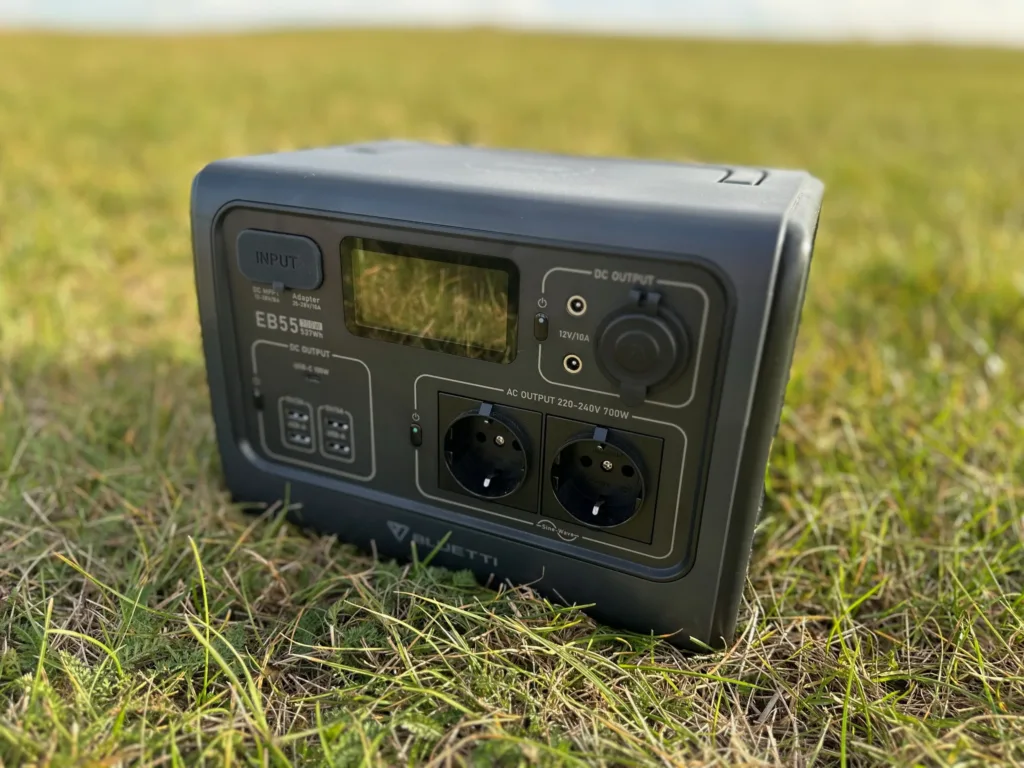
Zdroj: Dotekomanie
If you regularly spend weekends outdoors or take camping trips, chances are you’ve thought about bringing a dependable power source instead of relying on limited campsite hookups or your car’s 12V outlet. That’s where the Bluetti EB55 comes in. It’s a portable power station built to keep your gear running when you’re off the grid.
Bluetti EB55 packs enough power for your everyday gear
The Bluetti EB55 sits near the entry level of the company’s lineup, but it still offers enough capacity for the basics: phones, laptops, lighting, and even smaller kitchen appliances like a mini fridge or toaster. It uses a LiFePO4 battery, which brings better longevity and reliability than typical Li-ion packs.
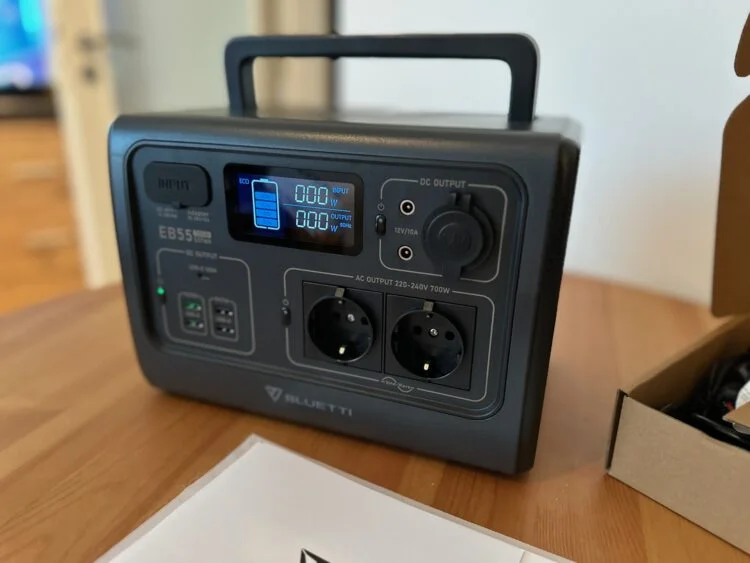

Bluetti says the battery retains 80 percent of its original capacity after 2,500 charge cycles. As for output, the station delivers up to 700W, while the battery itself offers a total capacity of 537Wh. In the box, you get the power station plus the cables you’ll need for wall charging, car charging, and solar panel input.
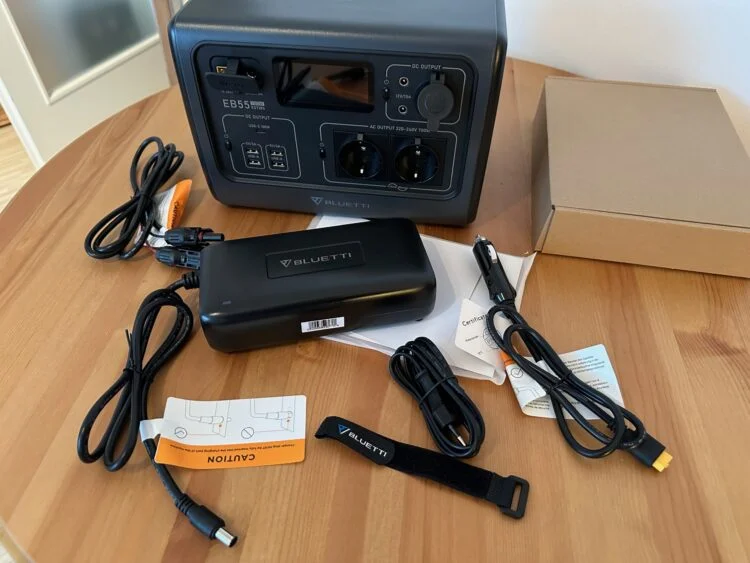
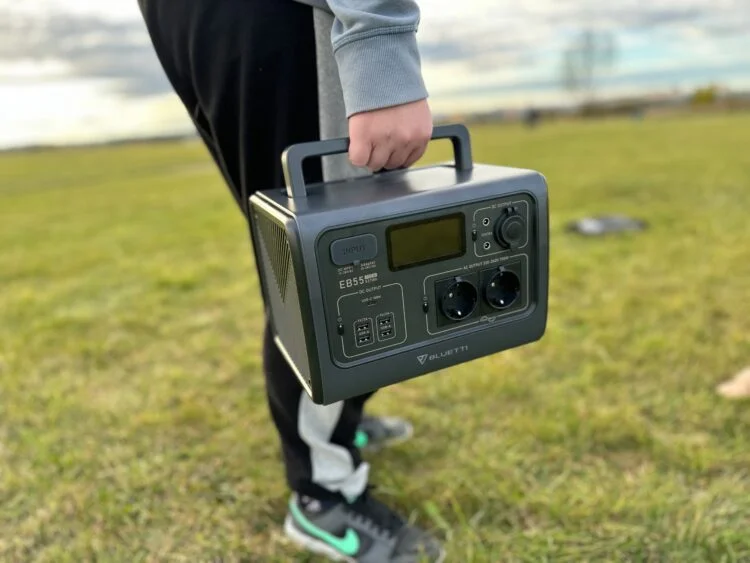
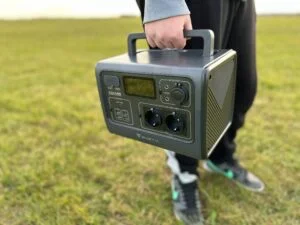
The size and weight are manageable enough to carry it like a piece of luggage. The EB55 weighs 7.5 kg and measures 27.8 x 20 x 19.8 cm. A folding handle makes it easy to grab with one hand. Still, this isn’t something you’d want to haul on a long hike or toss into a backpack. It makes much more sense for picnics, tent camping, road trips, or campground use.
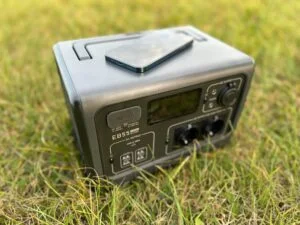
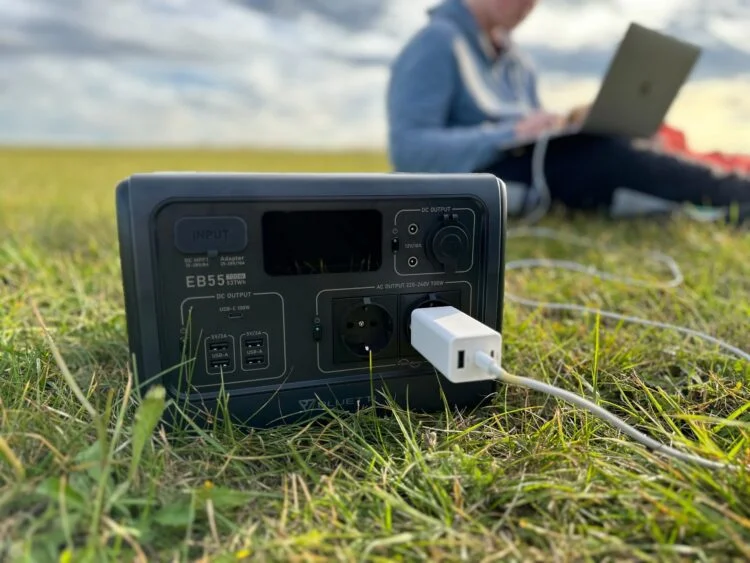
As the photos suggest, port selection is one of the EB55’s strengths. You get two standard 230V AC outlets, one 12V car socket, two 12V DC outputs, four 5V USB-A ports, one 100W USB-C port, and, as a nice extra, a 15W Qi wireless charging pad. In practice, that covers just about everything most people would want to power outdoors. Around back, there’s also a built-in light that works for general illumination and doubles as an emergency light with an SOS mode.
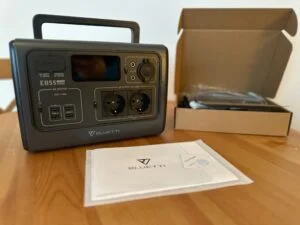
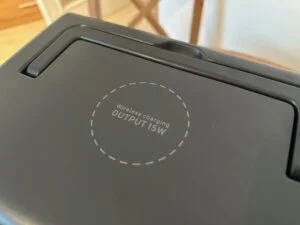
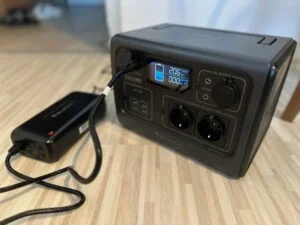

We tested the power station with the kind of devices people are likely to use in the real world: a laptop, different types of lighting, and even a smart TV. As mentioned, the EB55 tops out at 700W. If you plug in something that draws more power than the station can provide, the outlet shuts off. There’s also overload protection that kicks in above 1,400W. We tried a standard hair dryer rated at around 2,000W, and after a brief moment of operation, the unit immediately cut power and showed an overload warning on the display.
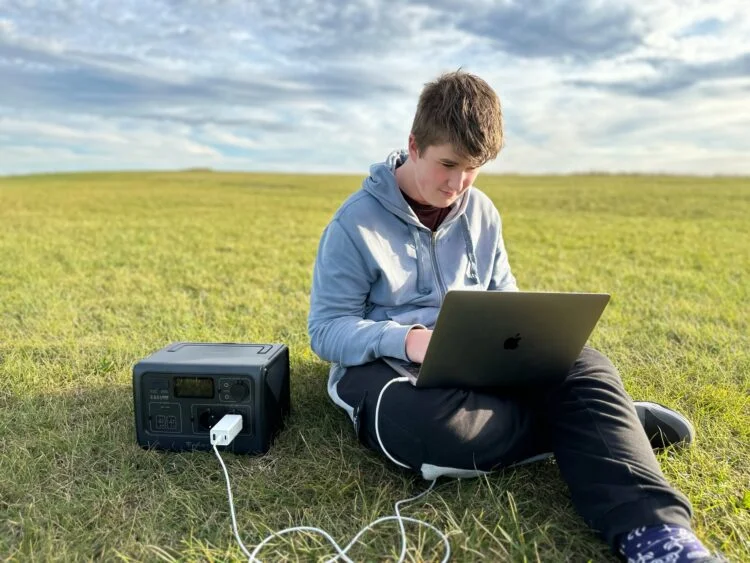
We used the EB55 to power laptops, room lighting, and a smart TV with power consumption of roughly 81kWh/1000h in SDR mode, with average draw around 80 to 90W. A full charge kept the TV running for about four hours. That lines up with the station’s 700W ceiling: you’re limited by maximum output, but that’s still enough for most of the gadgets and small appliances people typically bring on a trip.
When we started powering several devices at once, including a smart TV, one laptop charging, another in active use, and two phones, the station began to warm up slightly and the built-in fan kicked in. It’s fairly loud. We noticed the fan activating at around 120 to 130W. So yes, under heavier load, the EB55 gets noisier. Under lighter day-to-day use, though, it fades into the background.
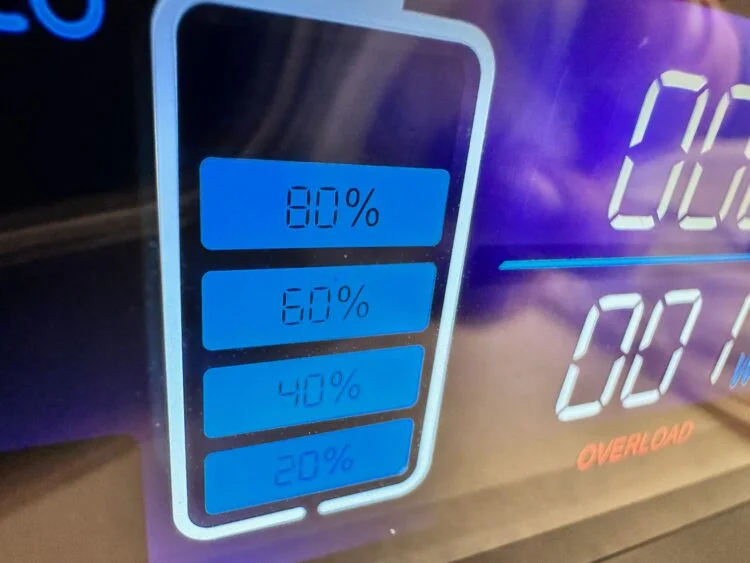
Up front, there’s a display that shows battery status. The main drawback is that it only reports charge level in 20 percent increments, which is less precise than it should be, especially when the battery is getting low. It also shows current output power when something is connected, and input power while charging. The screen remains easy to read even in sunlight. After a while it turns off automatically, and you can wake it by pressing any of the front buttons.
Charging from empty to full is rated at three hours, and that matched our experience. The included power adapter charges the unit at 200W. If you add a solar panel, sold separately, that can effectively double to 400W total, cutting charge time to around 1.8 to 2.3 hours depending on sunlight conditions. Charging from a 12V car outlet takes roughly 6.1 hours, though that too can be shortened with solar input.
So what’s the verdict? Mostly very good. We liked the wide range of output ports, which makes it easy to plug in almost any device or small appliance you’d realistically bring outdoors. The station offers enough power for most camping, picnic, and road-trip gear, and the LiFePO4 battery should outlast many competing models with standard Li-ion cells. The biggest miss is the lack of any IP rating or rain resistance. For a product designed for outdoor use, that feels like an obvious omission. On top of that, both the unit itself under load and the charging brick during recharging can get pretty loud because of their cooling fans. Still, at $399, or about 8,900 CZK (approx. $411 / €366), the EB55 delivers a lot for the money and is easy to recommend as a starter portable power station.
Pros
- Compact dimensions
- Solid build quality
- Enough capacity and output for commonly used devices
- Excellent port selection
- 100W USB-C and 15W Qi wireless charging
- Easy-to-read display
- Solar charging support, though the panel is sold separately
Cons
- Noisy charging adapter
- Battery level is shown only in 20 percent steps, which can be frustrating near empty
- No IP-rated water resistance
Basic technical specifications
Battery
- Capacity: 537Wh (22.4V, 24Ah)
- Battery type: LiFePO4
Outputs
- 2 x AC output 220 – 240V, 700W total
- 1 x USB-C up to 100W
- 4 x USB-A 5V/3A
- 1 x 12V/10A car socket
- 2 x 12V/10A (DC5521)
- 1 x Qi wireless charging up to 15W
Inputs
- 1 x 200W wall adapter
- 1 x 12/24V car input
- 1 x solar input up to 200W, VOC 12-28V, 8A
Charging
- 200W wall adapter: 3 hours
- 200W solar input: 3 hours
- Combined wall adapter/solar input up to 400W: 1.8 – 2.3 hours
Other parameters
- Weight: 7.5 kg
- Dimensions: 27.8 x 20 x 19.8 cm
- Operating temperature: -20 – 40℃