T-Mobile’s Robert Vávra on AI, network operations, and the road to 6G

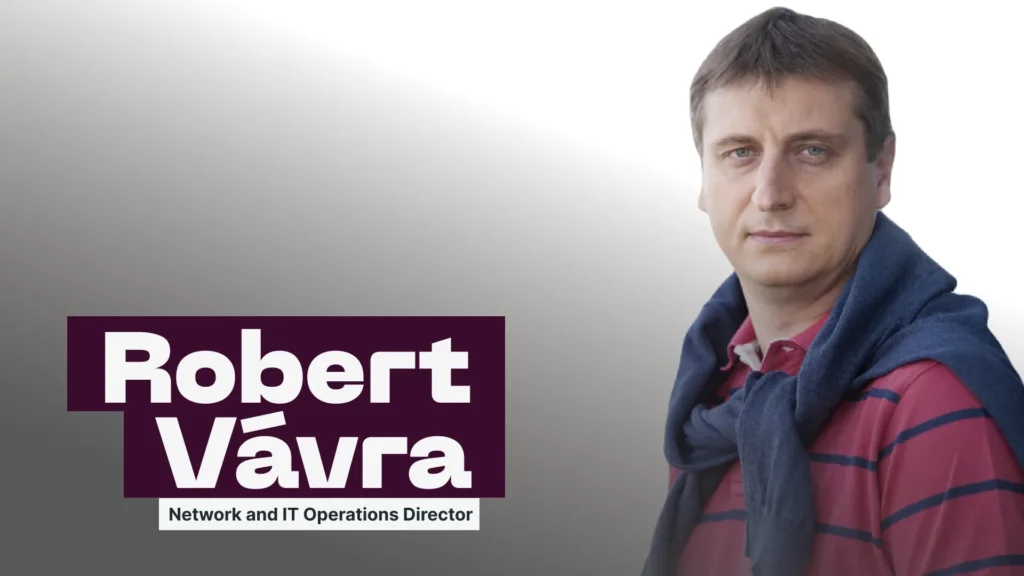
Zdroj: T-Mobile
Our guest this time is Robert Vávra, Network and IT Operations Director at T-Mobile. In this interview, he lays out a job that stretches well beyond telecom networks. He talks about how T-Mobile has evolved from a traditional carrier into a broader technology company, one that runs not just mobile networks but advanced IT services for businesses and institutions. He also looks back on his career, from the early internet era to his current role helping shape one of the market’s biggest players. The result is a conversation about technical pivots, major infrastructure bets, and where telecom is headed next.
Robert Vávra has been with T-Mobile CZ since October 2014. Since this was our first conversation, the interview was conducted in a formal style.
Hello, Mr. Vávra. I appreciate you taking the time to speak with Dotekomanie’s readers despite your packed schedule. Let’s start at the beginning. What did your career path look like before T-Mobile CZ?
Hello, Mr. Koutský, and thank you for the invitation. I’m glad to introduce not only my role, but also how we think about technology and the broader operating model at T-Mobile.
I entered telecom roughly 22 years ago, basically at the start of the internet as we know it today. We’re talking about the dial-up era, and even WAP, the predecessor to modern mobile data. I worked at several companies early on, starting with the alternative operator Contactel, which at the time used what was then a fairly groundbreaking voice solution, VoIP, or Voice over Internet Protocol. In a way, I never really changed employers after that, because Contactel was later acquired by GTS, which focused mainly on B2B customers. Over time, I worked my way up to technical director of the Czech unit. In 2015, Deutsche Telekom acquired the entire GTS group, and I moved to T-Mobile.
What was your role when you first joined T-Mobile?
At the beginning, my task was to build a B2B technology division. That meant combining GTS, T-Systems, and T-Mobile’s original B2B unit. Since 2016, when T-Mobile and Slovak Telekom were integrated, my department has been responsible for access, transport, and core networks, service platforms, and a lot more. It’s varied work, and I enjoy it a lot.
That’s a lot of change, isn’t it?
It is, but it was an interesting opportunity and, above all, a real challenge. Bringing B2B together and creating a coherent, functional business unit inside a large company is no small task. I also felt a moral responsibility toward the colleagues who made that transition with me.

Can you briefly describe your biggest professional achievements and challenges?
On the achievements side, I’d point first to the integration of T-Mobile, GTS, and T-Systems. From my perspective, we succeeded in building a technology organization that became a strong backbone for B2B customers and a direct partner to the commercial teams. It actively supported them. That surprised some major former GTS customers, because they expected us to turn into a slow, unwieldy corporate machine. Instead, we stayed agile even after the acquisition.
Another major success, and really the fulfillment of a long-term goal, was building the DC7 data center. We had been pushing for that for more than 15 years, and today DC7 is, in my view, the best commercial data center in the Czech Republic.
As for challenges, one recent example is the integration of T-Mobile CZ and Slovak Telekom. Internally, we call that process federalization, with some teams operating across both the Czech Republic and Slovakia.
Things change over time. Some models work better than others, some were simply ahead of their time, and sometimes a company circles back to an earlier solution. What didn’t work before may work later. Every process and every setup needs the right timing, and above all, clearly defined ownership. The moment everyone is responsible, no one really is. Very often it’s less about structure and more about people. If you don’t have the right people, the org chart won’t save you.
What exactly falls under your role as Network and IT Operations Director?
Together with the broader team, we’re responsible for fixed and mobile access networks in the Czech Republic and Slovakia. That also means taking care of the sites where those networks run. We also manage aggregation and transport networks, whether IP or xWDM, core networks, data center infrastructure from a networking perspective, and service platforms such as R4, IMS, and the mobile packet core. We also run the network operations center, which covers monitoring and supervision of the network, as well as IT platforms used for internal company communication, things like VDI, Citrix, Office 365, and conference room systems.
How do you contribute to T-Mobile’s strategic network development and optimization?
That’s a tough question. We’re primarily an operations organization. But operations is involved in every project and every major decision. We comment on development plans and try to keep the technology stack grounded in operational reality, so whatever our colleagues design can actually be run in production, and so deployment into the live network happens smoothly, without outages or customer impact.
On a personal level, I’m curious what it takes to keep a network running smoothly.
Pretty much everything. If I had to sum it up, we monitor, supervise, evaluate data, handle proactive upgrades, configure and connect new technologies into the network, and expand it, for example by adding OLT boxes for fiber internet deployments, increasing capacity, and so on.
To put that in perspective, when you update software on a PC or phone, you usually need to close the app and reopen it. Sometimes you even have to restart the device. You can’t do that with a telecom network. You’re not allowed to switch it off. That’s why network upgrades at an operator are such a demanding operation. We have to improve the network while making sure users don’t feel even a minute of disruption.

What’s your approach to innovation and the latest telecom technology trends?
Very positive. I’m at the stage now where some of the systems and technologies I helped build years ago are being shut down because they’ve become obsolete, while we bring newer ones online. That’s just how this industry works. Things move forward fast.
The contrast is striking. Ten or fifteen years ago, a telecom platform usually meant specialized vendor hardware running dedicated software. Today, if I simplify a bit, it’s increasingly just an application in the IT sense, running on standardized hardware in a data center and delivering a specific service. But that also changes the requirements around redundancy and operations. In the past, identifying a fault was relatively straightforward. Today, it’s harder.
Can you give some concrete examples of innovations implemented during your time at T-Mobile?
The pace of innovation has clearly accelerated. In the past, a standard would be developed over years, then run reliably for years. Now protocols evolve so quickly it can feel almost like alchemy.
Take voice services. They used to run primarily on 2G. With LTE, we moved to VoLTE, which is now one of the dominant forms of voice traffic on the network. Put simply, a traditional call today runs either through the still-functional, if aging, 2G network, or, in roughly 70 percent of cases, through VoLTE, where voice is carried as a data stream, similar in principle to calling through a messaging app.
How hard is it to move quickly on technology inside a large corporation?
Some innovations move faster and more easily than others. Some naturally take longer. It always depends on demand, the surrounding circumstances, and prioritization. The top priority is a customer need, when customers are clearly asking for a certain innovation.
We’re absolutely a company that wants to innovate and expand its services, and we have a big advantage as part of a multinational group operating across several markets. That means some technologies can be tested in one market and then scaled elsewhere, which brings real benefits to customers.
Since we’re talking about the rapid pace of new technologies, how do you see the AI boom overall? And is your department using it in any way?
My view is fairly measured. AI is still in the early stages, in my opinion, but development is moving very quickly. It clearly has an interesting future in network operations.
As for deployment, we coordinate our AI approach at the group level. We’re actively discussing it and testing it. We’ll see when broader rollout makes sense. Even now, though, we’re working to automate operations and use predictive tools that help us detect faults in advance. A large share of network monitoring is already fully automated, with predictive capabilities built on machine learning. We collect anomalies and patterns, then train the system on how it should respond in a given situation.
How do you handle network security and reliability?
Security and reliability are obviously central for us, and they’re addressed on several levels.
Which ones, specifically?
If I start with reliability and availability, that comes down to network topology and the amount of redundancy built into the system. On the security side, there are factors like how we approach the technology internally, who can access it, which parts they can access, and by what method. Any access is strictly monitored.
Then there’s the ongoing maintenance and updating of these systems. Applications are often vulnerable, so compared with the past, when a core network platform might be upgraded once a year, we’re moving to models and operating rhythms where we maintain and patch applications on a weekly basis. It’s always a balance between security and stability.
How large is your team, and where do you operate?
Today my team has about 230 people, and it’s a really strong group. It’s not about the headcount so much as the scope of work. And the work at T-Mobile still keeps me engaged.
We operate in both the Czech Republic and Slovakia. And as COVID-19 showed, today’s technology lets us operate from virtually anywhere. We can manage the Czech network from anywhere in the country, and even from abroad.
How do you see the future of telecommunications, and what role will T-Mobile play in it?
Well, of course I see the future as brightly magenta. (laughs) But seriously, when you look at younger generations today, being connected and sharing experiences with others often feels more essential to them than whether the water is running at home or the power is on.
That gives us a moral responsibility. We do influence younger users, and we should also be pushing for digital balance, online-offline boundaries, and education. Through a range of initiatives, that’s something we actively work on at T-Mobile as well.
Can you share T-Mobile’s plans and strategy for developing networks and services?
On the mobile side, you can expect 6G at some point, then likely 7G, 8G, and whatever comes after that. There will always be another wave of innovation. On the fixed side, we used to rely on twisted-pair copper and that was enough. Today we have fiber-optic lines inside plastic conduits, which for now is the most advanced data transmission technology available for households.
In mobile, we’ve gone from 2G and 3G to 4G/LTE and 5G, and more technologies will follow. In services and cloud platforms, you can expect a continued shift toward application-layer services. Beyond that, it’s hard to predict exactly what comes next, though broader use of virtual reality is one possibility.
We’d probably agree that the future also means responsibility. How is T-Mobile approaching social responsibility and sustainability in network coverage?
We’re one of the largest companies in the Czech Republic, and we clearly align ourselves with sustainable business practices. The first step is setting an ESG strategy and the goals tied to it.
We’re paying much closer attention to our carbon footprint and focusing on activities where we can make a real impact. One example is electricity procurement for our entire operation, networks, data centers, buildings, and more. We purchase 100 percent of it with a green certificate, meaning electricity generated exclusively from renewable sources.
Looking ahead, we aim to cover 50 percent of our electricity consumption through PPAs, long-term contracts that directly link a company with a specific renewable energy producer. We’re also installing solar where space allows, working on energy-saving measures across the network and our buildings, and changing heating methods where possible to reduce emissions.
Mobile networks themselves account for 58 percent of our electricity use, so optimizing and modernizing them is an obvious priority. Newer technologies deliver higher performance with lower power draw. In many cases they’re also smaller and less demanding in terms of cooling, which cuts energy use further. We’re also optimizing our data centers and trying to make greater use of free cooling. We’ve learned how to scale down activity at cell sites overnight, when data demand is lower.
Going forward, we also expect AI and machine learning to play a bigger role here, helping us distribute energy more efficiently and reduce consumption.
Step by step, we’re bringing ESG thinking into both our operations and our business because we believe it matters. One thing that has worked especially well is involving employees directly and giving them room to suggest ways we can operate more sustainably. Two years ago, during the energy crisis, we launched an internal program called ECCO2, which brings together all activities related to energy efficiency, lower consumption, and emissions reduction. Through a simple app, the program collects, evaluates, and helps implement ideas submitted by employees themselves.
That was a thorough answer, thank you. Let’s keep going. Do you run into obstacles when expanding telecom infrastructure?
A change to construction law would definitely help. We could build faster and build more. Anyone who has tried to build a single-family home today knows what that process looks like. You can easily spend at least a year and a half just getting permits and paperwork in order. And that’s for a structurally simpler project than telecom infrastructure, like laying cable in the ground rather than building a house.
Mobile infrastructure can be even more complicated. Our existing coverage is good, but user demands keep rising, and we’re ready for further expansion. These projects require approval not just from municipalities, but often from other authorities as well. In protected landscape areas or national parks, for example, the process gets even harder.
Sometimes, though, we do get great results. In Benešov, for instance, the city worked with us in a way that significantly helped with fiber deployment. In general, where there’s a will, there’s a way. Ideally with our fiber conduit built into that path. (laughs)
How do you work with government initiatives to expand coverage and telecom access in rural areas?
In rural areas, we of course fulfill the obligations tied to our spectrum licenses. We’re working to expand the network as much as possible, but it always depends on the current conditions and requirements in a given area. We take a pragmatic, realistic approach so that the result makes sense for us, for users, and for municipalities alike.
How do you work with the government during crisis situations, such as natural disasters or public health emergencies?
We always try to be helpful. During the pandemic, for example, we introduced unlimited data so customers could continue functioning remotely as much as possible. We also provide immediate support during natural disasters, tornadoes, floods, fires, and more. We try to be proactive and offer customers something extra when it matters most.
So what does the process actually look like when a crisis breaks out?
That depends on the nature of the event. We naturally have internal procedures in place whenever we identify an outage or an extraordinary situation. First, an operational response group is assembled to handle the issue. That’s led by the MOD, or Manager On Duty. Depending on the scale of the incident and the impact on customers, the next steps are determined.
That includes not just immediate verification of what happened and when service can be restored, but also legal and regulatory obligations, such as who must be informed and at what stage under protocol. Management and other internal channels are then updated.
Even in cases like local flooding, where we might lose some cell sites in a specific area and the event may not meet the legal threshold for a critical infrastructure emergency, we still inform the integrated rescue system and other relevant authorities in time. We may not be formally required to, but we still see it as our responsibility.