
We had the chance to test two tablets at the same time. Both came from Samsung, and both carried the Galaxy Tab name. One packs a 7-inch display; the other steps up to a 7.7-inch screen.
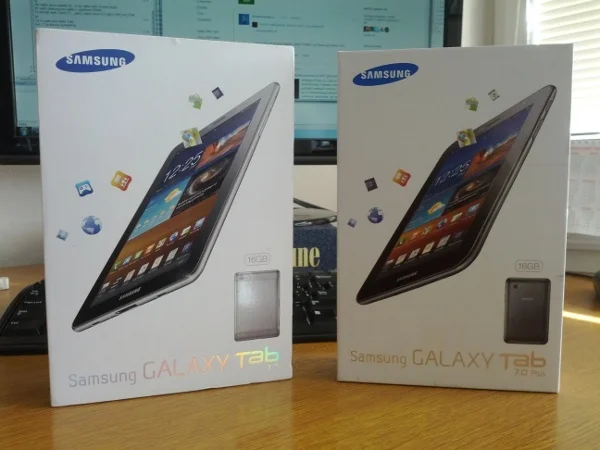
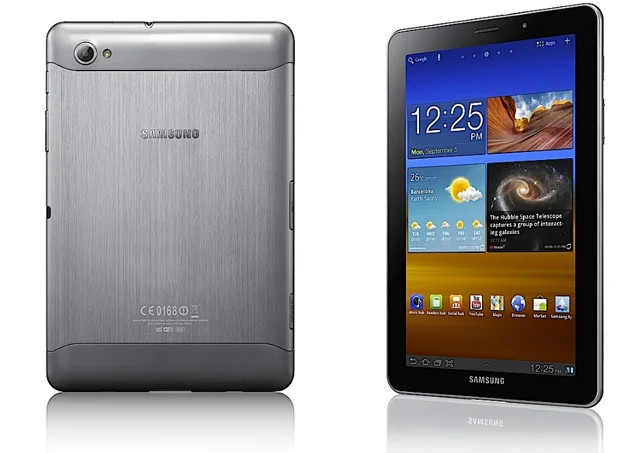
Most of the key details are covered in the video, but it’s worth adding a few personal impressions here too. Both tablets feel well built. I didn’t notice any creaking, flex, or that uneasy sense that something might snap under pressure. The Galaxy Tab 7.7 left the stronger impression, though, thanks to its aluminum body, which feels genuinely sturdy.
Performance is fairly close between the two. The larger tablet does have a slightly higher-clocked dual-core processor, but it also has to push a higher-resolution display. In everyday use, the two felt almost identical. Once I fired up a more graphically demanding game, the Galaxy Tab 7.0 Plus started to struggle a bit, while the Galaxy Tab 7.7 pulled ahead.
The displays are a different story. They’re completely different. The smaller Tab uses a TFT panel, while the 7.7 lights up with the punchy colors of Super AMOLED. Picking a winner isn’t simple. The higher resolution on the 7.7-inch model produces a sharper image, but in low light the screen can still feel too bright even at the lowest brightness setting. Documents are comfortable to read on the Galaxy Tab 7.0 Plus, but games and movies look flatter, with less vivid color. This really comes down to which display tech you prefer and what you want the tablet for. The panel technology also shapes the look of Android itself here, since AMOLED screens use less power with black pixels, so the interface leans darker.
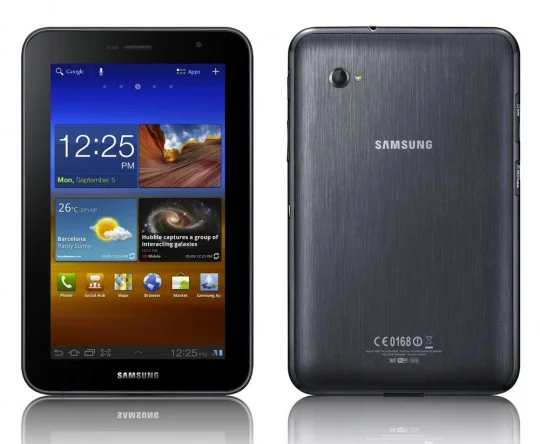
In the video, I mention the aspect ratios several times. If I’m giving my personal take, 4:3 still feels ideal. Even so, between these two I’d pick the Galaxy Tab 7.7, which uses a 16:10 aspect ratio, versus the narrower 16:9.3 on the smaller Galaxy Tab 7.0 Plus. The smaller tablet just feels too skinny.
We should also talk about pricing. According to Heureka, as of April 23rd, 2012, the lowest price for the Galaxy Tab 7.0 Plus was 10,180 CZK (approx. $468 / €418). In practice, though, it was usually selling for around 11,000 CZK (approx. $506 / €452). The Galaxy Tab 7.7 was a tougher sell on price. On the same day, it started at 13,490 CZK (approx. $621 / €554), with average pricing landing between 14,000 CZK and 15,000 CZK (approx. $644 / €575 to $690 / €616). Whether that feels expensive is up to you, but this article and the video should make that call a little easier.
What You Didn’t See in the Video
I also tested both tablets with a Bluetooth mouse and keyboard, though not at the same time. Both accessories worked without any trouble. The external keyboard had one interesting quirk: when Samsung’s keyboard was selected on the device, the Bluetooth keyboard used a Czech layout. When I switched to Smart Keyboard, it started behaving like it had an English layout instead.
Another odd detail: the Galaxy Tab 7.7 appeared to have some kind of software bug that would occasionally throw up a message saying “USB device disconnected,” even though no device had been connected beforehand.
If I compare Android Honeycomb on these smaller Samsung tablets with iOS 5.1, which I also had a chance to try on the new iPad, I end up split. Android offers huge room for customization. For me, the biggest advantage is being able to change the keyboard. I also like home screen widgets, and Samsung’s mini apps were genuinely useful. iOS, on the other hand, makes its case with total smoothness, instant responsiveness, and app stability. My takeaway is pretty simple: yes, Android works on tablets, but I’d much rather use it on something closer to the iPad in size, around 10 inches, and ideally with an aspect ratio that lands nearer to 4:3.
Smaller tablets in the 7- to 8-inch range didn’t win me over in a big way, even though the devices tested here make a strong case for themselves. Part of the problem may be that I use a Galaxy Nexus every day. At 4.65 inches, it already sits surprisingly close to a 7-inch tablet in practical terms.
Now it’s time for the video. Watch it and make up your own mind. The Galaxy Tab 7.7 is the more compelling of the two thanks to its better screen, stronger gaming performance, and sturdier build, but the Galaxy Tab 7.0 Plus still makes sense if lower pricing matters more than display quality.

Community Discussion 0 COMMENTS