Each week, our Tech Briefs round up news from research, development, and innovation that could reshape the future. We track advances in artificial intelligence, chips, robotics, quantum computing, and space, then break each story down into a few quick paragraphs:
Tech Briefs
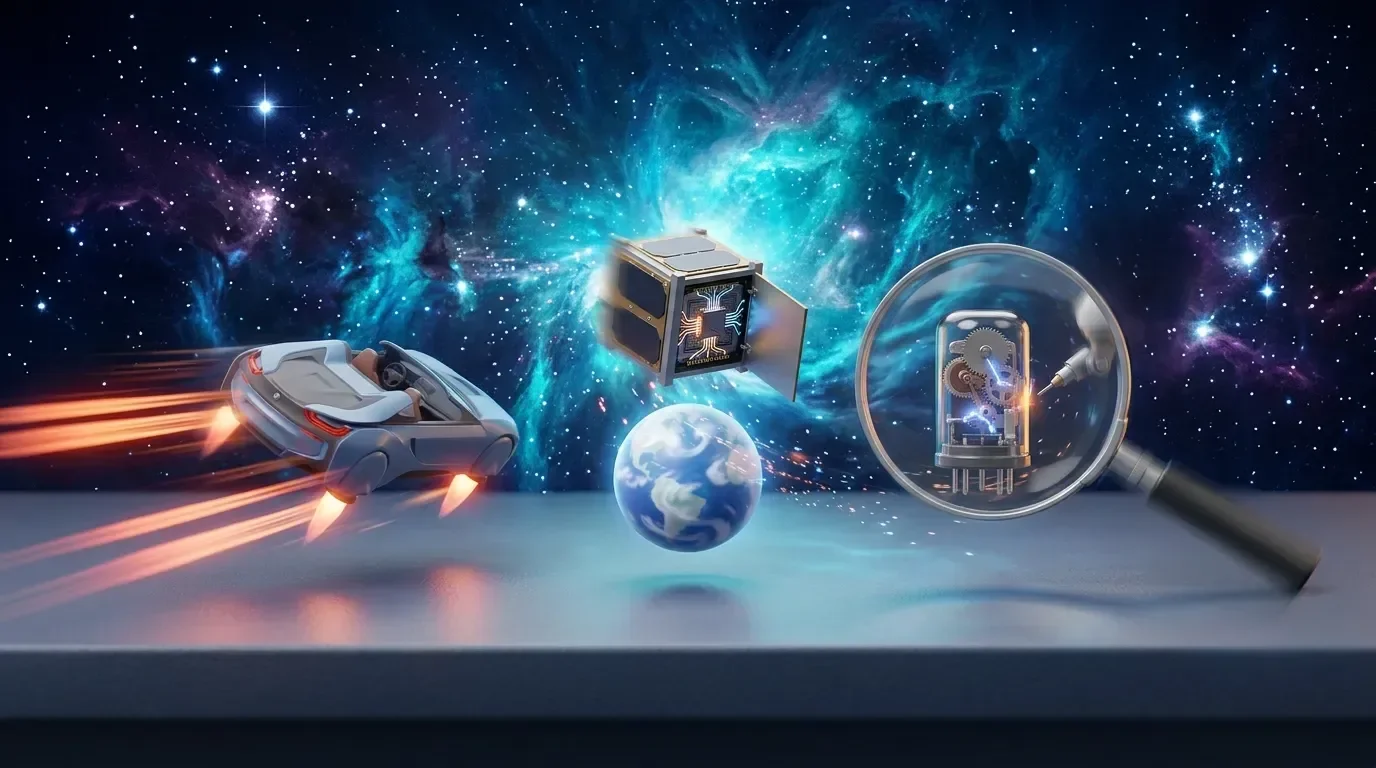
The new Tesla (in Czech) has thrusters and can do a kickflip. The newly unveiled (in Czech) Roadster from the American automaker sounds like something pulled straight from science fiction. It can reportedly cover short distances through the air and sprint from 0 to 100 km/h in under a second. Elon Musk said production will begin in 2028, and claimed the final production model will be even quicker.
Vienna researchers are testing a quantum computer directly in orbit (in Czech). A photonic processor from the University of Vienna, launched last June aboard a Falcon 9 rocket, generated and detected photon pairs and carried out programmed operations. The goal is to process satellite data in orbit instead of sending raw data back to Earth. The team also includes Czech physicist Patrik Zahálka.
A coin-sized quantum chip could bring eye diagnostics to children. UCL and startup Siloton are adapting the Akepa device, an OCT eye scanner that shrinks desktop optical hardware down to a chip smaller than a British pound coin. The aim is a version that can be used at home or in a community center instead of a hospital, including for spotting early signs of brain tumors visible on the optic nerve head.
TypeSafe has released Jev, a model built for fast decision-making. The System One series model takes a message and, instead of returning text, outputs a response software can work with immediately. It reacts in under a tenth of a second and costs $0.042 per million input tokens, with output free of charge.
A factory can build working micromachines straight from code. After six years in stealth, Atomic Machines has introduced Matter Compiler. “3D printing can now create programmable shapes: any geometry, directly from a file. We are creating programmable machines,” the company says. The machines the startup produces include moving parts, multiple materials, and features measured in single-digit microns. They require no molds, masks, or other fixed tooling. The system measures and corrects every step in real time, while its AI runs its own experiments on the hardware.
Cleaning water with light and urea. Researchers at CEITEC BUT are testing a photocatalyst made from graphitic carbon nitride, produced from urea, that breaks down pollutants when exposed to light. In the lab, it reached up to 97 percent efficiency in water containing methylene blue. The project is still early; the next target is microplastics.
A plasma antenna can broadcast a radio signal. A team at North Carolina State University has created a plasma antenna. A laser ionizes a narrow column of air, which then emits radio waves across a wide band, and its length can be adjusted. It still can’t receive a signal. The next step is testing in low Earth orbit.
Concrete can store energy. Chinese researchers have printed cement supercapacitors with electrodes made from carbon nanotubes, carbon black, and cement. Three units on a single slab were enough to light a small LED array, though they stopped working at roughly -18°C. Their strength is comparable to standard concrete used for slabs and stairs.
GPS with centimeter-level accuracy. Xona will launch six satellites later in October aboard a SpaceX rocket as the start of its Pulsar constellation, which is planned to include 258 satellites. The company promises a signal that works indoors and resists jamming and spoofing. Full coverage is targeted for 2028.
Quantum spin has moved a centimeter-scale object for the first time. The Okinawa Institute of Science and Technology used electron spins in a levitating diamond. Billions of NV centers, driven into a defined state by a laser, created changes in the magnetic field that pushed the diamond downward. According to the paper, this is the first direct observation of a quantum effect in an object strongly influenced by gravity. The study appeared in Science Advances.
You can follow more updates and news here.
Community Discussion 0 COMMENTS