Every week, our Tech Briefs roundup brings you news from research, development, and innovation that could one day reshape how we live. We track what’s happening in AI, chips, robot (in Czech)ics, quantum computing, and space. Here’s each story in a few sentences:
Quantum sensor could measure Earth’s effect on spacetime curvature. American physicists have proposed a new type of quantum sensor based on superfluid helium. In lab conditions, it could measure how Earth drags the surrounding spacetime along with it. The effect, predicted by general relativity, is caused by the rotation of a massive object.
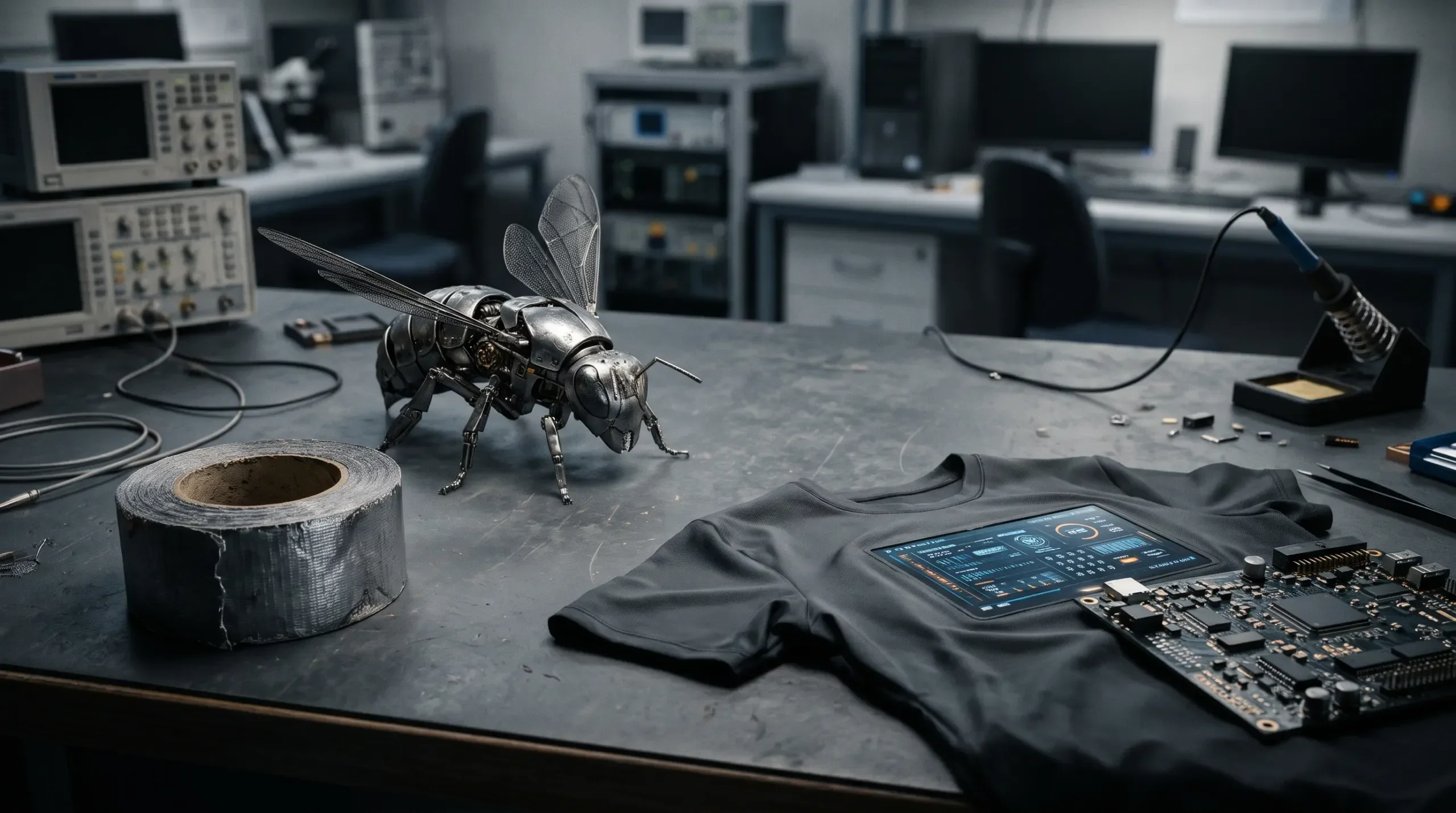
This insect robot is hard to kill. The flying machine from US researchers weighs just 185 milligrams, and even a fly swatter won’t stop it. Its wings are made from flexible polymer layers. When voltage is applied, one layer contracts while the other expands, creating the flapping motion needed for liftoff.
Adhesive tape could help during floods. A British team tested silver repair tape applied to the outside of a door and cut floodwater leakage by 97 to 98 percent. Sandbags, by comparison, reduced leakage by at most 70 percent. Applying the tape takes 10 to 20 minutes. Water also didn’t get through walls, floors, or drains. For now, though, this was only a lab test.
Custom PCBs made overnight. Czech startup CircuitNinja is launching ultra-fast PCB manufacturing in Prague. These boards are everywhere in consumer electronics. The company fuses fiberglass fabric with copper foil into a rigid copper-clad board, uses a laser to draw the exact circuit pattern, and chemically etches away the excess copper. The full process, however, remains under wraps.
Czech scientists slowed a molecule’s motion with light by roughly 300,000 times. A team led by Jiří Kaleta at the IOCB Prague slowed the mutual rotation of two parts of a single molecule. A light-controlled molecular motor changes shape and stops an otherwise randomly spinning rotor. Earlier systems managed only about a 100x slowdown. The long-term target is molecular machines, including systems that could transport drugs.
A touchscreen display woven directly into a shirt. A team of researchers in Singapore built a touchscreen display from fibers with a resolution of 96 × 54 pixels across 168 × 105 mm. It can show 30 frames per second and supports 8-bit color depth. It’s wireless and, according to its creators, durable enough to survive washing.
Brain organoids read Braille. A US research team stimulated organoids of roughly 10,000 cells using signals from a robotic tactile sensor. One organoid identified the correct letter 61 percent of the time; three working together reached 83 percent accuracy. The letter encoding was predefined, so the organoids were not learning from experience.
Quantum chips passed 99.9 percent logical fidelity. Google reported 99.99 percent logical fidelity on its 105-qubit Willow chip. Quantinuum’s Helios processor then posted about five errors per million logical operations, or 99.9995 percent success, a tenfold improvement over its own September record.
A robot with a phone for a torso. UCLA has built a walking robot that stands 19 inches tall and uses an Android (in Czech) phone as its body, including the camera, motion sensors, and processor. The rest of the parts cost about $400.
You can follow more updates and news here.⤴
Community Discussion 0 COMMENTS