
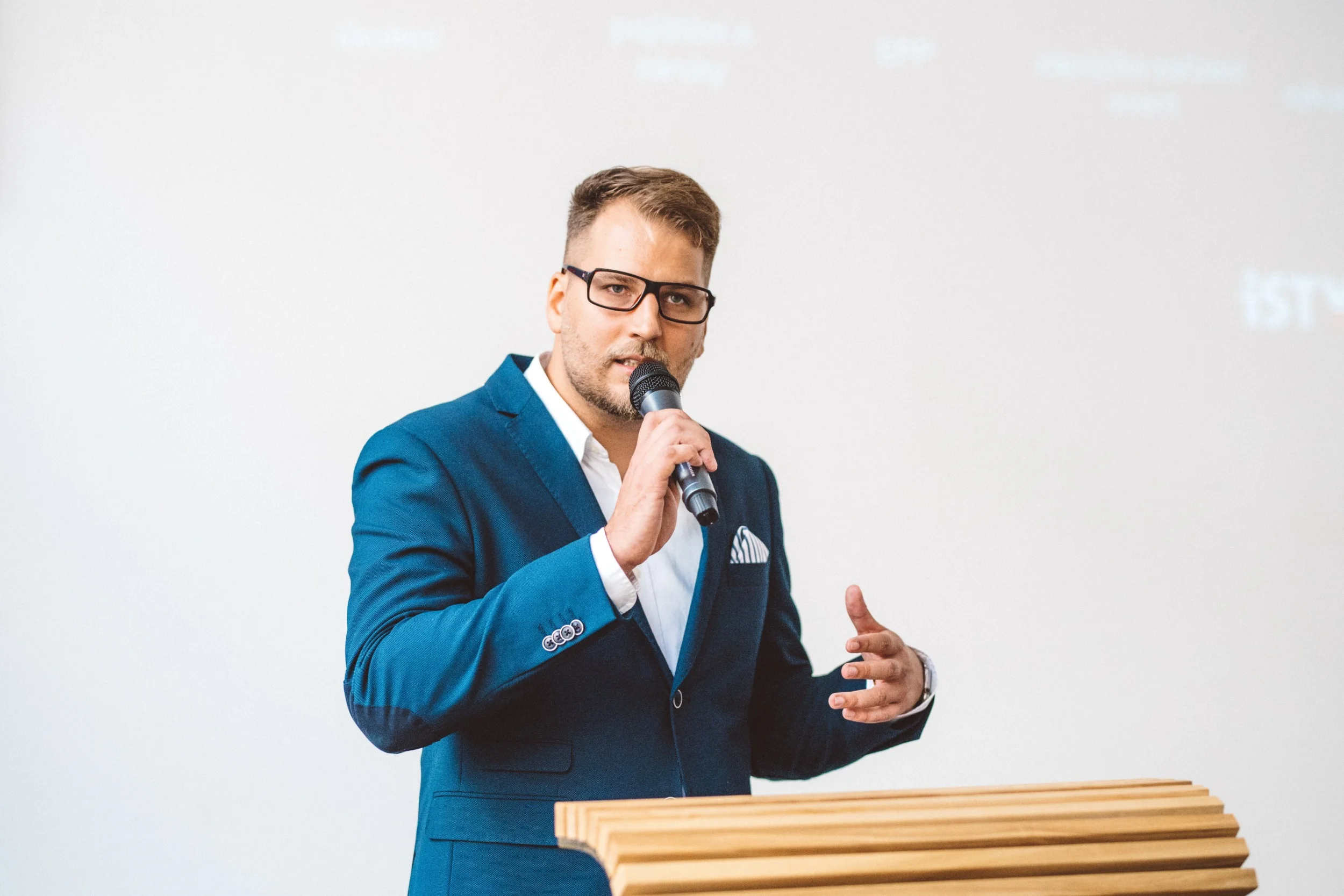
Matyáš Rezek, sales manager at iStyle, joined us for an interview to explain how the company has moved far beyond brick-and-mortar retail, expanding into B2B deployment and device management for businesses and institutions.
Rezek has worked in sales at iStyle since March 2015. We hadn’t previously met, so the conversation stayed in a formal register.
Matyáš, can you introduce yourself to our readers? What’s your role at iStyle?
My name is Matyáš Rezek, and I oversee the entire B2B division at iStyle. We work with mid-sized and large companies, so enterprise clients, including brands like ČEZ, Škoda Auto, banks, and other major organizations by revenue and headcount.
What were your early days at iStyle like?
I joined iStyle basically right after school. Before that, I had a few part-time jobs and one role in administration. I started at iStyle eight years ago focused on education, then we expanded into small and mid-sized businesses, and over time I moved into my current position.
You mentioned B2B. In the context of a certified Apple reseller, what does that actually mean?
There are several ways we connect with potential clients and build partnerships. One is through public tenders, which anyone can look up in the public contracts registry. For example, we handled a major contract for the Ministry of Defense, where we supplied thousands of iPhones. Then there are public institutions such as schools. Education makes up a significant share of our sales in that public-sector segment. And in the case of ČEZ, we also came in through a standard procurement process.
Public records show that you supply devices to the Czech military. How did that happen?
I can’t go into detail because of confidentiality, but it was a standard public contract. Part of it came down to the fact that Apple devices are standard across NATO, and it also followed a major procurement by Austrian police, which bought a large number of Apple devices. That sparked a big public debate at the time, but the police did a strong job explaining that, beyond security, the move also made clear economic sense.
And how does it usually work in the private sector?
We hold Apple’s highest Apple Premium Partner status and have nearly 20 years of history in the local market, so in many cases a company reaches out to us based on a specific need and asks for the services it wants. It may also invite other authorized resellers into the process for comparison. Usually, the purchasing or IT department already has a rough idea of how many devices it wants, what kind of deployment it needs, and so on. We then recommend and deliver a specific solution. We also maintain a database of relevant companies and Apple global customers that we contact directly. Another big advantage for us is our broad retail footprint. Even business customers visit those stores, which gives us a chance to introduce additional services, including deployment and device management.
How does device deployment work, and what services come with it?
We integrate devices into existing infrastructure and provide additional services such as Mobile Device Management, or MDM. That gives IT administrators a way to manage hundreds of devices and make sure they’re configured according to company policies and operational needs.
What are the main pillars of your business, and how does your approach differ between B2B and consumer customers?
The main pillars of our business are retail, online, and B2B, and their relative weight shifts over time. As a result of Covid and now events like the war in Israel, where many multinational companies have offices or headquarters, we’re seeing corporate customers act much more cautiously and delay purchases. Apple Silicon has also extended hardware life cycles, so companies often no longer feel the need to replace hardware after two years. In many cases, that cycle has stretched to three or four years. Right now, the consumer segment is carrying more of the business, where people buy these devices as both tools and personal purchases.
Has the economic climate and global instability changed your client mix or the way you win new business?
Yes, absolutely. We’re more active in the market now, and acquiring new clients is a major focus. We’re concentrating mainly on mid-sized companies, where we believe we can offer the most added value. We can handle outsourced IT, so we’re not just offering a strong product but also strong services. I’d say the level of our technical team is genuinely unusual in this market.
Where do you see your biggest advantage? Why do companies choose you as a partner?
It’s mainly about long-term experience with the products and the path we’ve already walked with many of our partners. I also think it comes down to the fact that we listen to clients and don’t push them into anything. We’re not trying to create a homogeneous environment, and we’re not saying Apple is the only right answer. We know a company may have Windows servers, printers, or departments that prefer Windows PCs for their own reasons. We focus on our platform, and we know how to implement it in highly heterogeneous environments so employees across the company can work comfortably. Our mantra is that employees should be able to choose what they work on. They’re more productive that way, and it benefits the company too. We’re not here to pressure anyone into buying a MacBook. There are many good hardware makers and sellers on the market. We’re one of them, we stand behind these products, and we can explain their advantages, but the final choice should belong to the user.
What does outsourcing IT actually mean in practice?
IT outsourcing includes support, device management, network setup, and solving other technology issues so employees can work effectively and IT becomes a benefit instead of a barrier.
Security is often a major factor for companies. Do you educate users in that area too?
Apple and security are closely linked, and we emphasize that in conversations with clients. We don’t step into internal company rules about what employees can or can’t do, since those organizations usually have dedicated departments for that. What we can do is align device behavior with company policy through MDM and make sure risky actions simply can’t be performed.
To give one example, Mobile Device Management lets us configure each computer in depth so it becomes very difficult to upload or share content in unauthorized ways. You can block copying files to flash drives, uploading files to unapproved storage services, restrict access to inappropriate websites, and more.
Doesn’t that hurt the user experience too much?
We can separate work and personal environments on a device and control which apps have access to corporate data. That means employees can work safely and comfortably with sensitive information, but only within approved environments. If they want to open a file from a personal Gmail account, they can still do that in whatever app they prefer. It can all be configured in very fine detail.
What’s the hardest part? What do the typical technical challenges look like when deploying at large companies?
At this point, we’re so prepared for the enterprise world, where Microsoft infrastructure still dominates, that it’s no longer much of a technical challenge. Thanks to our software and app partners, we can respond to client needs and connect to almost anything. Five years ago, I would have said it was a challenge, but today we know the terrain and compatibility is on a completely different level. If you look at the world’s 500 biggest companies, all of them use Apple in some form and have those devices integrated.
A challenge might be a client request for very specific document behavior, but that’s exactly why we have a technical team that can custom-build that part and let people in the company keep working the way they’re used to.
That almost sounds too easy.
Of course, deploying anything new is always a challenge. But the biggest challenge is user anxiety. People are conservative by nature, and if you change something they’ve used for five years or more, they’ll be cautious. Over time, we’ve learned to use what we call the “six brave ones” system.
What does that mean?
At the start, a few brave early adopters volunteer to be the pioneers. They want the devices, they want to try the new system, and they’re happy to test and report back. They help us clear the path for everyone else, because once the rest of the company sees it works, they want it too.
Let’s talk about the advantages of Apple’s ecosystem. What does a company actually gain? And what about employees?
From my perspective, the biggest thing is usability. I’m not dealing with updates because the computer handles them on its own. It doesn’t restart in the middle of the workday. Battery life holds up, and I can rely on the device. It’s just a machine that works. Data security is obviously a big advantage, but what really sets it apart is the ecosystem. Apple is still the only company building around a tightly integrated combination of its own hardware and software. Other platforms try to get close with additional apps, but here it’s built in by default, with a full security layer, and I don’t have to set anything up. It just runs.
What about price? Can you compete with Windows device sellers whose upfront prices can be much lower?
Yes. Upfront price is one thing, but total return on investment matters more and more to companies. There’s a good study from Forrester Consulting showing that over a longer period, Apple devices can actually end up significantly cheaper than competing products. That comes down to the energy efficiency of Apple’s newer chips, lower IT support costs, and the much stronger residual value of Apple hardware. If a company buys a MacBook, it knows it can still sell it for a solid price a few years later. That changes the real cost equation quite a bit.
Can you help with that resale process too?
Yes, we can cover the full device life cycle. We can advise clients on the best time to sell their devices and help execute that process, either directly or through partners. We also run special offers aimed at B2B and SMB customers, and those tend to get a very positive response.
Right now, for example, we’re running a promotion in which a new MacBook Pro with 16 GB of unified memory is priced the same as the 8 GB version for business purchases. That means an immediate savings of 6,000 CZK (approx. $277 / €247), and it also improves the residual value of the device when the company eventually wants to refresh its hardware.
Apple itself puts a lot of emphasis on environmental issues. What’s your view on the environmental side of electronics, and how are you trying to reduce the impact?
We try to work with suppliers that follow environmentally responsible practices, and we also support second-life programs and device recycling. We want to minimize waste and support a more sustainable approach to electronics. And the nature of Apple hardware itself helps on that front. It’s not just about packaging or recycled aluminum. There are studies showing that the shift to Apple Silicon significantly reduces the energy footprint for companies. At large organizations with hundreds of devices, the difference in power consumption is meaningful.
 Source: iStyle

Community Discussion 0 COMMENTS